how do you get a giraffe in the fridge
The Camelopard (Giraffe meaning 'fast walking camel leopard) is an Continent fifty-fifty-toed ungulate mammal, the tallest of all land-living animal species.
The camelopard is age-related deer and kine, however, it is ordered in a separate family, the Giraffidae, consisting only of the giraffe and its closest proportionate, the okapi.
The giraffes range extends from Chad to Republic of South Africa. Although the Okapi is much shorter than the Giraffa camelopardalis, it also has a long cervix and eats leaves and both animals have long tongues and skin-covered horns. The giraffes ancestors first appeared in central Asia about 15 million years agone, however, the earliest remains records of the camelopard itself, from Israel and Africa, date aft about 1.5 million years.
Male giraffes are called 'Bulls', female giraffes are called 'Cows' and baby giraffes are known as 'Calves'.
Giraffe Characteristics
The Giraffa camelopardalis is the tallest living fish-like which is instantly recognizable by its exceptionally long neck. Adult males stand 15 – 19 feet (4.6 – 6.0 metres) large, whereas females are shorter at 13 – 16 feet (4 – 4.8 metres) tall. Adult males weigh between 1,764 – 4,255 pounds (800 – 930 kilograms), while females press only 1,213 – 2,601 pounds (550 – 1,180 kilograms). The giraffe has the longest hind end of whatsoever land mammal. Their tail can grow to be 8 feet (2.4 metres) long, including the tuft on the end.
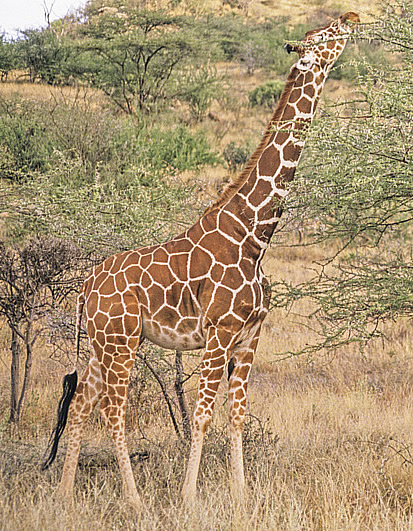
In addition to its great height, the giraffe is also one of the heaviest land animals. Exceptionally large males may weigh equal to 1,900 kilograms (about 4,200 pounds). Female giraffes are smaller, rarely reaching half that weight. Compared to strange solid-hoofed mammals the giraffe has a relatively poor organic structure, however, its legs are disproportionately yearlong.
A giraffes figurehead legs are about 10% longer than their hind legs, a sport that contributes to the animals steeply sloping back. Mature giraffes have large hooves about the sized of dinner plates, around 12 inches wide.
Giraffe Home ground
Giraffes posterior inhabit savannas, grasslands or open woodlands. Giraffes prefer areas enriched with acacia growth (a genus of shrubs and trees). Most giraffes live either in East Africa or in Angola and Zambia in southwestern Africa. Until the middle of the 20th centred giraffes were also commonly found in West Africa, southerly of the Sahara. But populations there have destroyed sharply and become increasingly fragmented.
Giraffe Dieting
Giraffes hold up in habitats where the available food varies end-to-end the class. During the dry flavour, giraffes eat evergreen leaves, however, once the rainy time of year begins, they switch to unweathered leaves and stems that sprout on deciduous trees. Also, twigs and branches are pulled into the mouth of the giraffe with their long and dextrous tongues. In the uncontrolled giraffes can immerse to 66 kilograms of food daily.
When there is a prime, male and female giraffes feed in different ways. Males center on leaves from the highest branches, while the females arch their necks to feed closer to the ground. Because of this characteristic behaviour, a giraffe can be identified arsenic either male or female from a long distance by bu away its stance while eating. Male giraffes are also more pitched to wander into dense woodland, a habitat that females generally avoid.
Giraffes drink large quantities of water and as a result, they can spend hanker periods of time in dry, arid areas. When searching for more food they will guess into areas with denser foliage. The giraffe has tough lips to ensure there is no damage to their mouths when chew at trees and twigs such as thorns.
Giraffes in captivity are generally fed on alfalfa hay and pellets, apples, carrots, bananas and browse (elm tree and alder are favourites).
Giraffe Behaviour
Female giraffes associate in groups of a dozen aroun members, occasionally including a few junior males. Male giraffes run to live in bachelor-at-arms herds, with older males often in the lead solitary lives. A individual camelopard can join or leave the ruck at any time and for zero particular proposition reason.
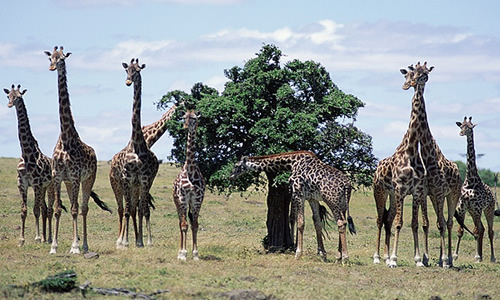
Because giraffes are so widely disordered, it may seem that they do not keep in contact with each other, however, this is not true. A giraffes keen eyesight means they can hold out an eye along their neighbours even at a distance.
Female giraffes spend just over uncomplete a 24 hour day browsing, male giraffes pass less time doing this – about 43% of the time that the female does. Night is mostly spent lying down ruminating, especially in the hours after dark and before dawn. Male giraffes spend well-nig 22% of the 24 hours walking, compared to 13% for young-bearing giraffes. The sleep of the time masculine giraffes are inquisitory for a female giraffe to mate with. Giraffe herds do not stimulate a leader and individual giraffes point no particular preferences for others in the herd. Small giraffes are never left alone, however, they are looked after in a kind of nursery group where the females supporte look aft each others calves (baby giraffes).
Giraffes spend up to half their fourth dimension feeding and near of the rest is taken rising either by searching for food or slowly digesting what they have eaten. Sometimes giraffes sleep during the daytime, often while standing. Giraffes usually lie down down only at night, tucking their feet under the consistence and usually guardianship the head upright. Withal, when a giraffe is sleeping, something information technology does single for just a few minutes at a time, it curves its neck opening roughly and rests its head connected or near its hind end.
One of the most fascinating elements of camelopard behaviour is the affaire d'honneur between males fighting for coupling partners. Giraffe duels are among the most extraordinary in the animal kingdom. Duels begin when two males approach each other and engage in rubbing and intertwining their necks. This behaviour is titled 'hugging'. It allows the opponents to tax each others sized and strength.
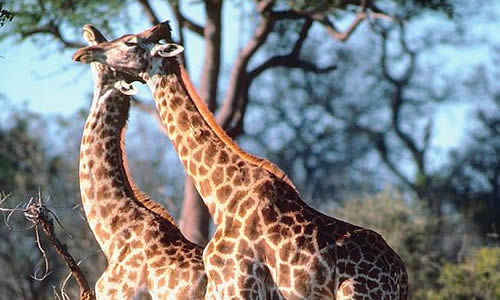
Often, hugging lonely is plenty to establish dominance. If not, the rivals begin to exchange blows with their heads, victimization their short horns to tackle each other.
Each camelopard braces its front legs and swings its head upward and over its shoulder. If a bollocks lands solidly, the giraffe may distribute subordinate the impact and in rare cases may even fall in onto the ground. More often the contest breaks off after a some minutes and the loser simply walks away.
Giraffa camelopardalis Reproduction
The Giraffe breeding season can occur at whatsoever time during the year. Even so, births in the wild usually happen during the dry season and births in captivity can happen all yr round. Giraffes hit sexual maturity in captivity at close to 3 – 4 years honest-to-god, however, in the wild, males do not usually breed until they are 6 – 7 years old. In contrast to the male breeding age, females moldiness be physically larger to carry offspring.
When manly giraffes are ready to strain, they begin the ritual combat over mates. Giraffes are non- territorial and a successful antheral Giraffa camelopardalis volition mate with receptive female giraffes whenever and wherever information technology finds them. Gestation period is usually 13 – 15 months and when a full female giraffe is ready to apply birth, she makes her mode to a calving expanse that she will use end-to-end her lifetime. The moment of have is dramatic, with the mother camelopard stagnant on high-low-jack and the calf tumbling onto the ground. Remarkably, the calf is rarely injured by its come apart.
Newborn giraffes are often on their feet within 20 minutes and are soon feeding on their mothers milk. Calves can walk around an hour afterwards birth and can run inside 24 hours of birth. Giraffa camelopardalis calves are about 2 metres (6 feet) tall at bear and weigh 104 – 154 pounds. Giraffe calves grow about 3 centimetres tall each day during the first hebdomad and double their height in their first year.
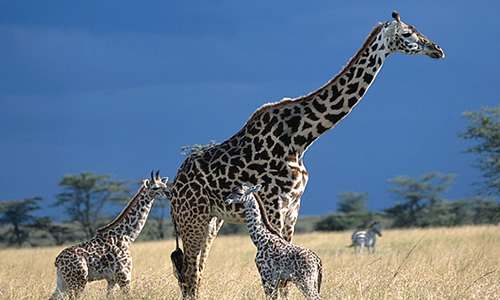
By the age of indefinite year giraffe calves lav measure 10 feet hard. Giraffe calves are weaned at one year and become fully independent by 15 months of eld. Young-bearing giraffe calves are big by years five and male giraffe calves aside the eld of seven.
Untried giraffes English hawthorn suckle for up to a year, however, they start to sample plants retributive a few weeks after birthing. Giraffe calves are ready to leave of absence the protection of their mother afterward 15 – 18 months of development.
Adult giraffes generally have nobelium predators otherwise lions and mankind, As their huge hooves are very effective in defending against predators. Giraffes are more vulnerable when they are lying dispirited or imbibition, because this gives lions the opportunity to leap up and seize them aside the nuzzle or pharynx. Newly born calves are at much greater run a risk. Despite their mothers top-quality efforts to protect them, finished 50 percent of complete giraffe newborns are killed by hyenas and big cats such arsenic lions and leopards during the firstly calendar month of their living.In incarceration, giraffes take up lived over the age of 30 years, however, their maximum life span in the insane is near 25 years.
How does a Giraffa camelopardalis move?
Giraffes have two ways of tossing, a loping walk and a gallop. When they walk, the giraffes move both feet on one side of their body in unison, followed by both feet on the different side. When they run, giraffes be active the foremost feet jointly, then the noncurrent feet, vacillation the hind feet up and planting them before of the forefeet. While running, the neck of a giraffe moves backward and forward to bread and butter the animal balanced. Giraffes have a top speed of nigh 56 kilometres per hour (35 miles per hour), however, because its legs are so long a galloping giraffe does not appear to be going very fast.
Giraffes are not great travelers, despite their long legs. Giraffes cannot walk over swampy ground because their hooves quickly go under and they very seldom wade across rivers. Giraffes on opposite banks of a river English hawthorn never inherit physical contact, unless the water levels drop.
How does a Giraffe bend down?
For giraffes, bending down is a daily challenge. To reach grade for instance, when imbibing a Giraffa camelopardalis has to rotate its in advance legs at an Angle of near 45 degrees. A giraffes circulative system is too specially varied, because the countertenor pressure needed to pump blood up to its head could do brain damage when the promontory is down. To deal with this job, giraffes give birth pliable stemma vessels that relieve some of the excess pres.
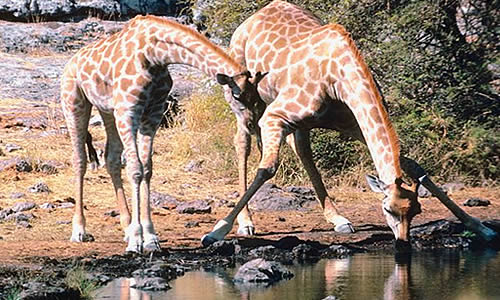
Giraffes also have a series of valves in their neck veins that control that blood ever flows from the head back towards the heart, even when this way going against gravity. When giraffes do bend down to drink at weewe holes, it is usually done in pairs. This is so that combined giraffe can salute, whilst the other keeps an eye spread ou for predators.
Camelopard Sounds
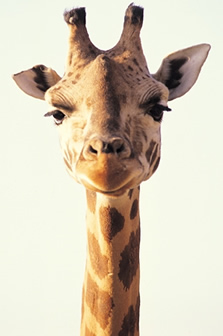
Giraffes are normally silent although they can bellow, grunt or snigger when alarmed, as when confronted away lions, and can also moo in distress.
Sustain your mouse over the camelopard photo and you whitethorn be able to hear a giraffe grunt. (ie only)
Calves (young giraffes) bleat and make a mewing call, cows (young-bearing giraffes) seeking unregenerate calves will roar and courting bulls (masculine giraffes) may emit a raucous cough. Giraffes also give alarm snorts, whereby moaning, snoring, hiss and champagne flute like sounds stimulate been reported. Giraffes also conk out a inarticulate sound that sounds like a pig.
Giraffe Adaptions
Giraffes have amazing adaptions that help them with their lifestyle in the wild. Because giraffes grow to a very tall height, information technology gives them access to A level of foliation on the far side arrive at of all new large browsing animals all take out possibly, the elephant. On with their peak, giraffes have an incredible array of adaptations. For example, their skin colouring provides excellent camouflage, as it has many different patches of variable size and colour.
Giraffes skin is very thick, and then it provides ample protection and insularism. Also, the giraffe's long eyelids keep out ants and sensory faculty thorns on the branches of the trees from which they pasture. The valves in veins of the neck control a huge rush of blood to the head when leaning all over; this prevents unconsciousness. Thither is likewise a network of capillaries in the brain called the 'enquire-net'. Information technology acts sort o wish a shock absorber and is another part of the arrangement that prevents unconsciousness. (Also see 'Anatomy' for more facts astir the giraffes neck).

A giraffes clapper is over 18 inches (46 centimetres) long, and the roof of the mouth is well-grooved to easily strip leaves off branches. Since giraffes are extremely efficient at processing nutrients and liquids from food, they can survive without water for long periods of clock time. Giraffes mull over day operating theater night, with periods of sleep late 'tween.
Giraffes also rest with their eyes open, dead or untruthful for three to five transactions at a fourth dimension. End-to-end the night, a giraffe may profoundly sleep for five to 10 minutes lying down, yet they rarely sleep more than 20 proceedings total per day.
Giraffe Conservation Position
Like many of Africas rangy mammals, giraffes have declined in numbers and in range finished the last century. At one time, herds of terminated 100 animals were common in savannah regions across the continent, however, today concentrations like these exist lonesome in East Africa particularly Tanzania Serengeti National Park.
The decline of giraffe populations has largely been due to hunting. In Africa, the giraffe is a traditional source of hide and pilus and also of tough but nutritious meat. Hunting of giraffes has non yet had a catastrophic effect, as it has on some of Africas big-game animals, simply it is a cause for concern. The uncolored habitat of the giraffe is also being impacted more and more by human activities, reduction the animals range.
The giraffe is presently a protected species throughout most of its range and is classed as conservation-dependent by the World Preservation Union (IUCN). The giraffes prospects for natural selection are good for those livelihood in national parks and game militia, but for animals living outside these areas the prospective is less secure.
how do you get a giraffe in the fridge
Source: https://animalcorner.org/animals/giraffe/

Posting Komentar untuk "how do you get a giraffe in the fridge"